In modern manufacturing, achieving a stable and uniform emulsion is essential for consistent product quality. From cosmetic creams and lotions to pharmaceutical suspensions, food sauces, dairy products, and chemical formulations, many products depend on the controlled dispersion of one liquid into another.
However, simply combining oil and water is not enough. Without sufficient shear, mixing time, and formulation control, droplets may remain too large or unevenly distributed, resulting in phase separation, inconsistent texture, poor appearance, or reduced product stability.
A High Shear Mixer provides an efficient solution for these applications. By using a high-speed rotor-stator mixing system, it generates intense local shear and turbulence to break down droplets and distribute them throughout the continuous phase.
At CreWin, we provide high shear mixing solutions for laboratory development, pilot production, and industrial manufacturing. Depending on the product formulation and process requirements, high shear mixers can be configured as batch, inline, or vacuum-compatible systems.
This guide explains how high shear mixers work, what factors affect emulsification performance, how to select the right equipment, and when a high shear mixer or homogenizer may be more appropriate.
What is Emulsification with a High Shear Mixer?
Emulsification is the process of dispersing one immiscible liquid into another liquid to create a relatively uniform mixture.
A typical example is the combination of oil and water. Because oil and water naturally separate, mechanical energy and, in many formulations, emulsifiers are required to create and maintain a stable dispersion.
More complex formulations may also use multiple emulsions, such as W/O/W or O/W/O systems.
The final emulsion characteristics depend on many variables, including formulation, emulsifier system, phase ratio, temperature, viscosity, mixing intensity, processing time, and equipment configuration.
Two common emulsion types are:
Water-in Oil (W/O) Emulsions
In a water-in-oil emulsion, water droplets are dispersed throughout a continuous oil phase.Typical applications include:
Certain cosmetic
creams:Ointments,
Protective creams,
Oil-based formulations
Oil-in-Water (O/W) Emulsions
In an oil-in-water emulsion, small oil droplets are dispersed throughout a continuous water phase.Typical applications include:
Cosmetic lotions
Facial creams,Milk and dairy products
Salad dressings,Mayonnaise
Pharmaceutical emulsions
What is a High Shear Mixer?
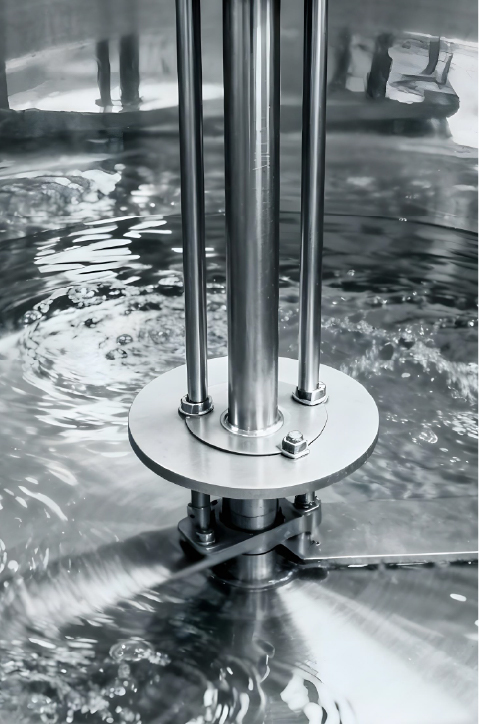
A High Shear Mixer is a mechanical mixing device designed to generate high levels of localized shear and turbulence within a liquid or semi-liquid product.
The most common design uses a rotor-stator system.
The rotor rotates at high speed inside or close to a stationary stator. As the product passes through the narrow working zone between the rotor and stator, it experiences:
A conventional agitator primarily moves the bulk material around the vessel. A high shear mixer, in contrast, concentrates mechanical energy in a small working zone to generate much higher local shear.
High velocity gradients
Intense shear
Turbulence
Rapid circulation
Droplet breakup
Improved dispersion
This makes high shear mixers particularly useful for emulsification, dispersion, wetting, deagglomeration, and other processes where conventional low-speed agitators may not provide sufficient energy.
4. Droplets Are Redistributed
After being reduced in size, the droplets are distributed throughout the continuous phase.
Repeated circulation through the high-shear zone can further improve dispersion and uniformity.
5. The Emulsion Develops Its Final Structure
The final emulsion is not determined by the mixer alone.
A stable product generally requires the correct combination of formulation chemistry and mechanical processing.
This is why equipment selection should always be considered together with the actual formulation and process conditions.
How does a High Shear Mixer Works?
1. Product Enters the Rotor-Stator Zone
The rotating rotor creates circulation within the vessel and draws the surrounding liquid toward the high-shear zone.
For inline systems, the product is continuously pumped through the rotor-stator assembly.
2. High-Speed Rotation Generates Shear
The intense turbulence breaks up droplets and distributes them evenly throughout the continuous phase.
3. Large Droplets Are Broken Down
When an emulsion passes through the high-shear zone, larger droplets can be disrupted into smaller droplets.
The extent of droplet reduction depends on factors such as:
Rotor speed
Rotor-stator geometry
Shear intensity
Processing time
Product viscosity
Phase ratio
Temperature
Key Benefits of High Shear Mixing for Emulsification
CreWin’s high shear mixers offer key advantages for emulsification:
1. Improved Droplet Uniformity
✔A properly selected rotor-stator system can reduce large droplets and improve the uniformity of the dispersed phase.More uniform droplets can contribute to improved product appearance, texture, and physical stability.However, the achievable droplet size depends on the complete formulation and processing system rather than mixer speed alone.
2. Faster Emulsification
✔High shear mixing can significantly accelerate the dispersion and emulsification process compared with conventional low-speed mixing alone.This can help manufacturers:
Reduce processing time
Increase production capacity
Improve equipment utilization
Reduce energy consumption per batch in some applications
3.Repeatable Processing
✔Industrial production requires more than achieving a good result once.The process must be repeatable from batch to batch.Industrial production requires more than achieving a good result once.A properly designed high shear mixing system allows important parameters such as:
Mixing speed
Processing time
Temperature
Vacuum level
Feed rate
Recirculation rate
This helps manufacturers maintain more stable product quality during repeated production.
4. Suitable for a Wide Range of Viscosities
✔High shear mixers can be used with a broad range of liquid and semi-liquid products.Depending on the equipment configuration, applications can include:
Low-viscosity liquids
Medium-viscosity emulsions
Creams
Suspensions
Lotions
High-viscosity formulations
5.Flexible Equipment Configurations
✔High shear mixing systems can be designed in different configurations depending on the production process.The mixer is installed directly into a mixing vessel.This configuration is suitable for:
Batch High Shear Mixer
Batch production
Cosmetic creams
Lotions
Food products
Chemical formulations
Inline High Shear Mixer
✔The product is continuously pumped through the high-shear mixing chamber.Inline systems are useful when manufacturers require:
Continuous processing
Recirculation
High throughput
Integration with existing pipelines
Vacuum High Shear Mixing System
✔A high shear mixer can also be integrated into a vacuum-capable vessel.This configuration is particularly useful for products where air entrainment, foaming, or oxidation needs to be controlled.
How to Choose the Right High Shear Mixer for Emulsification
When selecting a mixer for emulsification, consider the following:
1.Define The Emulsion Type
First determine whether the product is:O/W,W/O,Multiple Emulsion,Suspension,Dispersion.
The formulation and process requirements will influence the mixer configuration.So,It's important to confirm what kind of emulsion type.The mixer should be selected based on the actual working volume rather than simply the nominal vessel capacity.
2.Define the Required Production Capacity
You should determine: Batch Volume,Working Volume,Maximum Volume,Number of Batches Per Day,Required Production Rate.
If you are new to the industry, equipment with a capacity of 50 or 100 liters is a sensible choice.If your product has stood the test of the market, you can expand production capacity—for instance, to 500, 1,000, 5,000, or even 10,000 liters.
3.Determine Whether Vacuum Is Required
Vacuum should be considered when the formulation is sensitive to:Viscosity: Air Entrainment,Foaming,Oxidation,Bubble formation.
Vacuum can also help improve the appearance of certain cosmetic products and reduce air bubbles before filling.
4.Consider Heating and Cooling
If the formulation requires temperature control, the mixing vessel may be equipped with a jacket.Depending on the process, the jacket can be used for:Batch size and scale: Heating,Cooling.
Heating can also help reduce viscosity during processing, while cooling can help control final product properties
Typical Applications
Cosmetics: Body Lotions,Face Creams,Serums,Cosmetic Gels, Sunscreen Formulation s,Ointments,Personal Care Emulsions.
Pharmaceuticals: Mixing APIs into Suspensions and Emulsions,Topical formulations
Chemicals: Dispersing Pigments, Waxes, Polymers, and Surfactants,Adhesives
At CreWin, we evaluate the complete process, including:Product type,Formulation,Viscosity,Batch volume,Processing temperature,Cleaning requirements,Machine Structure.Based on these parameters, the mixing system can be configured according to the actual application.
Videos:See Our Machines in Action
https://youtu.be/jAS88p29ibA
https://youtu.be/dE5kt2aWN_o
FAQs
What kind of emulsions can I make with a high shear mixer?
Our pharmaceutical mixers are designed to meet cGMP, RoSH, ISO,and CE requirements, with comprehensive documentation to support validation, qualification, and regulatory audits.
What kind of emulsions can I make with a high shear mixer? You can create oil-in-water (O/W), water-in-oil (W/O), and complex multiple emulsions with excellent uniformity and droplet control.
What droplet size can a high shear mixer achieve? Depending on formulation, shear rate, and time, CreWin’s mixers can achieve droplet sizes down to 1 micron or smaller.
What’s the difference between a high shear mixer and a homogenizer? High shear mixers mechanically shear with rotor-stator systems, ideal for primary emulsification. Homogenizers apply pressure-based shear, better for finishing or ultra-fine emulsions.
Do I need a vacuum mixer for emulsification? Vacuum is recommended for cosmetics or pharma products where air entrapment and oxygen exposure need to be minimized.
Ready to create flawless, shelf-stable emulsions? Contact CreWin to design your high shear mixing solution today.

 ZS Lab Vacuum Emulsifying Mixer