Vacuum Emulsifier Homogenizer

Products

Vacuum Emulsifier Homogenizer

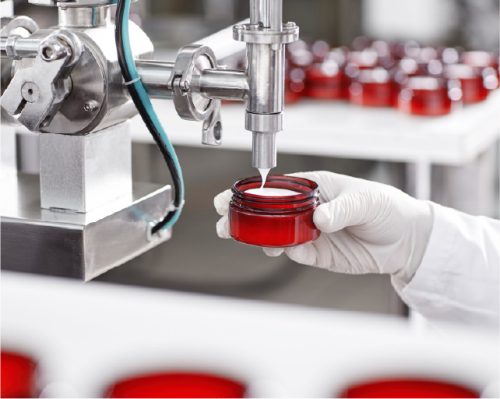
CreWin's vacuum emulsifier homogenizer machines are used in cosmetics, pharmaceutical, food, and chemical manufacturing for the processing of creams, lotions, ointments, and emulsions. Follow the links below to explore specifications, features, and application details.

introduce

What is Vacuum Emulsifier Homogenizer

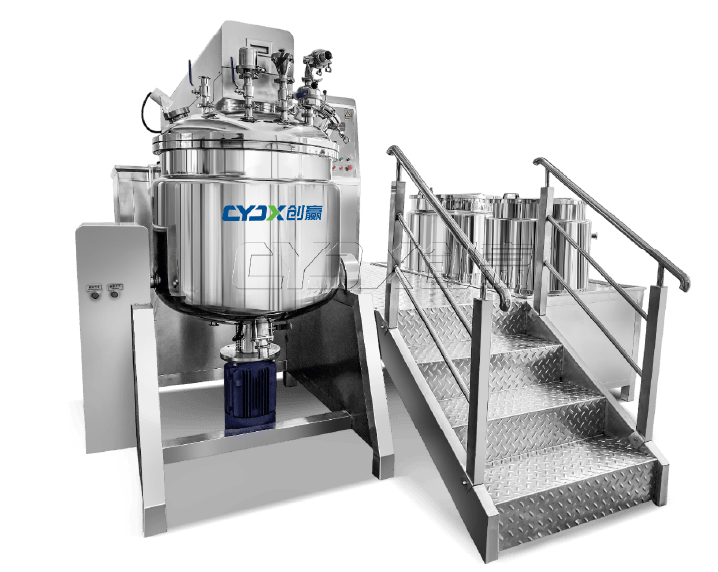
A vacuum emulsifier homogenizer is a machine that creates stable, high-quality emulsions, dispersions, and suspensions through high-shear mixing and vacuum deaeration. It is used in industries like cosmetics, pharmaceuticals, and food to produce products such as creams, lotions, and ointments. The vacuum system removes air to prevent oxidation, improve product texture, and ensure a homogeneous and stable mixture.

Key Functions

  • Emulsification & Homogenization

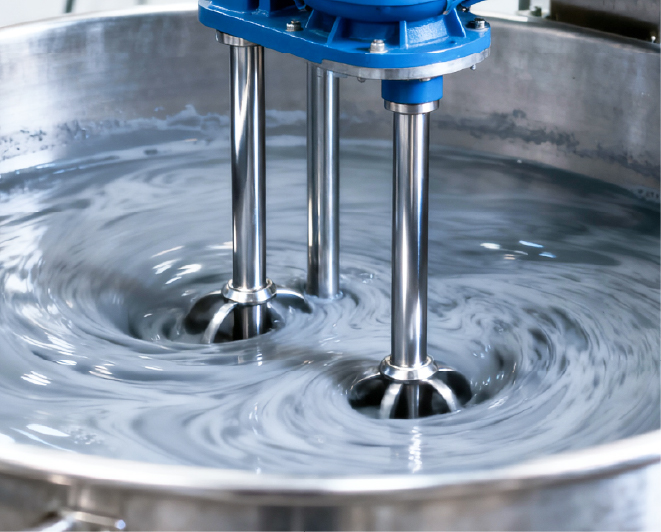
    Uses high shear to create a stable, fine emulsion of immiscible liquids (e.g., oil and water), resulting in a smooth, uniform product.

  • Vacuum
    De-Aeration

    Operates under negative pressure to effectively remove air and bubbles, preventing oxidation and improving product stability, density, and appearance.

  • Efficient
    Mixing

    Utilizes multi-functional agitators (often including wall scrapers) for uniform mixing of the entire batch and efficient heat transfer.

  • Temperature Control

    Equipped with a jacket for precise heating and cooling of materials.

Applications

Common Applications

FAQs

Vacuum Emulsifier Homogenizer FAQs

RO Reverse Osmosis System
    Overview
    RO Reverse Osmosis System is a water purification system designed to remove impurities, minerals, ions, and microorganisms from water for industrial production use. It is widely used in the cosmetics, pharmaceutical, food, and chemical industries where high-purity water is required during manufacturing.
    Natural tap water may contain chloramines, nitrate, phosphate, silicates, and other unwanted substances. These impurities can affect product quality, cause scaling inside equipment, and reduce the service life of boilers and processing systems. For many industrial applications, purified water is necessary to maintain stable production conditions.
    How it works
    The RO system works by using pressure to push water through a semi-permeable membrane. This membrane has extremely fine pores that allow water molecules to pass while blocking most dissolved salts, minerals, bacteria, and organic impurities.
    Before reaching the RO membrane, the water usually goes through pre-filtration to remove larger particles. After that, a high-pressure pump drives the water through the membrane system. The purified water is collected as product water, while the concentrated impurities are discharged as waste water.
    Advantages
    One of the main advantages of an RO system is its ability to consistently produce high-quality purified water. It helps protect equipment from scaling, corrosion, and fouling caused by untreated water.
    It also reduces maintenance frequency and system downtime, which improves overall production efficiency. With stable water quality, manufacturers can maintain better product consistency and meet strict hygiene requirements in cosmetic, pharmaceutical, and food production.
    In addition, the system helps extend the lifespan of production equipment and reduces the risk of unexpected breakdowns caused by poor water quality.
    Automatic Filling and Capping Production Line
    Overview of Filling and Capping Production Line
    Automatic filling and capping production lines are designed for liquid product manufacturing and packaging in the food, pharmaceutical, cosmetic, daily chemical, and chemical industries. The complete line usually includes mixing equipment, storage tanks, filling machines, capping machines, labeling machines, conveyors, and packaging systems.
    The production line supports different packaging types such as PET bottles, glass bottles, jars, cans, and other customized containers. Depending on the production requirement, the line can be designed for semi-automatic or fully automatic operation.
    Working Process
    The production process normally starts from raw material preparation and mixing. After the product is processed and transferred to the storage tank, the liquid is delivered to the filling machine through pipelines or pumps.
    The filling machine automatically fills the product into containers with controlled filling volume. After filling, the bottles are transferred to the capping system for automatic cap placement and tightening.
    The products can then enter the labeling system, date coding system, and final packaging section for carton packing or case packing before shipment.
    Applications
    Automatic filling and capping production lines are widely used for sauce products, syrup, shampoo, lotion, detergent, cosmetic liquid, pharmaceutical liquid, beverage products, and chemical liquids.
    Different industries require different filling solutions depending on the product viscosity, bottle shape, and production standards.
    Advantages
    The automatic filling line helps improve production efficiency and reduce manual labor during manufacturing. Stable filling operation also helps improve product consistency and reduce production errors.
    Customized production lines can be designed according to different factory layouts, production capacities, and packaging requirements. The system is suitable for both small batch production and large-scale industrial manufacturing.
    How to Choose the Suitable Filling Production Line
    To select a suitable filling production line, several important factors should be confirmed before equipment design.
    The first is the product information, such as viscosity, foam condition, filling temperature, and whether the product contains particles.
    The second is the packaging container. Bottle pictures, dimensions, cap types, and packaging forms are important for selecting suitable filling and capping systems.
    Production capacity requirements should also be considered, including bottles per hour or daily output. In addition, the required automation level, such as semi-automatic or fully automatic operation, will directly affect the production line configuration.

    Hydrogel Eye Patch Production Line
    Overview of Hydrogel Eye Patch Production Line
    The Hydrogel Eye Patch Production Line is designed for automatic manufacturing of bottled hydrogel eye masks in cosmetic production. The system integrates cooling, forming, stacking, cutting, and bottling processes into one continuous production line.
    The machine adopts a dual-layer drying and freezing tunnel to help maintain gel stability and support better product consistency during production. Different cooling systems such as fan cooling or air-conditioning cooling can be selected according to the production requirement.
    Depending on the configuration, the production line can be designed with 9 to 20 stations and achieve production capacities from 600 to 1800 bottles per hour. The equipment also supports semi-automatic and fully automatic production solutions with optional international brand electrical components.
    Working Process
    The production process starts with crystal cooling, where the hydrogel material is stabilized under controlled temperature conditions. After that, the material enters the air-cooled solidification section to form the hydrogel structure.
    The formed eye patches then go through automatic compounding and reciprocating stacking for multi-piece arrangement. After stacking, the products are automatically cut into the required shape and transferred into containers through the automatic bottling system.
    During operation, excess material is discharged automatically to keep the production area clean. The finished products are then transferred to the next process for labeling and final packaging.

    Have other Questions for Us? Ask Our Experts Directly