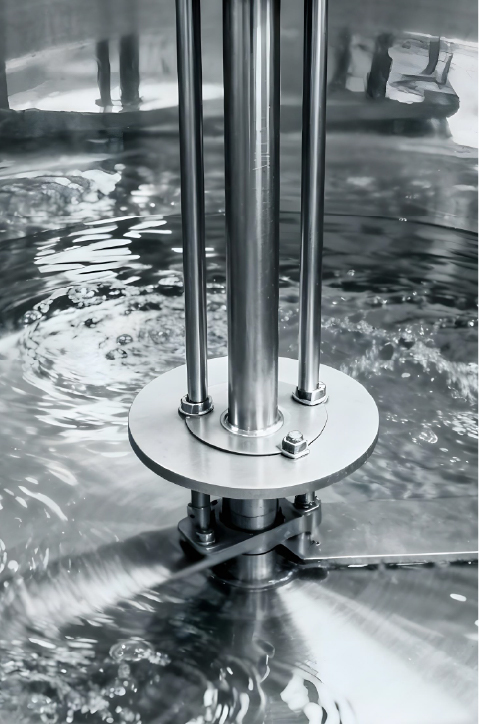
Modern Toothpaste Manufacturing

introduce

Industry Definition: The Technical Essence of Toothpaste Production

Toothpaste manufacturing is far more than simple mixing; it is a sophisticated homogenization process involving complex rheological control. When handling formulations ranging from high-viscosity CMC gels to abrasive silica, the core challenge lies in achieving microscopic uniformity while eliminating invisible micro-bubbles and ensuring 100% active ingredient activation.

Explore Products

Ointment Formulation

Active ingredients are carefully balanced with excipients, stabilizers, and preservatives to create a formula that is effective, safe, and user-friendly.

PROCESS & FORMULATION

Production Process & Formulation

To ensure product stability and premium texture, the manufacturing process follows a synchronized sequence designed for maximum efficiency:

  1. The liquid base is established by pre-mixing water and humectants under precise temperature control to ensure a consistent starting viscosity.
  2. All rheology modifiers are processed through a high-shear head before entering the main vessel to achieve a completely lump-free dissolution.
  3. The vessel’s internal vacuum is utilized to induct abrasive powders directly below the liquid surface, which eliminates airborne dust and prevents air entrainment.
  4. For high-viscosity white pastes, dual planetary scrapers are engaged to maintain constant movement and eliminate any stagnant "dead zones" near the vessel walls.
  5. Active ingredients such as fluorides and preservatives are then introduced and distributed precisely throughout the homogenized base.
  6. The entire batch undergoes high vacuum processing up to -0.02 MPa to extract micro-bubbles, resulting in a dense, high-gloss finish.
Ingredient Type Typical Ratio Key Function CYJX Technical Insights: Mixing Hurdles
Liquid Base (Humectants) 30% - 80%

Retains moisture, prevents drying, and maintains texture.

Requires precise temperature control to integrate with powders; viscosity fluctuates with temperature, affecting dispersion.

Abrasives & Fillers 15% - 50%

Polishing and plaque removal.

Wetting & Dust Control: Low-density powders tend to float. Vacuum induction is essential to prevent agglomerates and airborne dust.

Rheology Modifiers 0.5% - 2%

Controls flow and stand-up (ribbon) properties.

Eliminating "Fish-eyes": Polymers form clumps instantly. High-shear hydraulic force is required to break the molecular barriers for full hydration.

Surfactants (e.g., SLS) 0.5% - 2.5%

Foaming and flavor dispersion.

Aeration Control: Extremely shear-sensitive. Without a vacuum environment, entrained air leads to inaccurate filling weights and dull appearance.

Active Ingredients 0.3%

Cavity prevention (Fluoride).

Distribution Uniformity: Requires high-efficiency homogenization for micron-level distribution of trace elements across multi-ton batches.

Flavors & Sweeteners 0.5% - 2%

Palatability and freshness.

Volatile Protection: Must be added at the final stage with precise mixing to ensure emulsification without phase separation.

Download Printable Version
Problem

Problems with Using Traditional Mixers

The toothpaste industry faces several critical manufacturing hurdles that traditional equipment often fails to address:

  • Traditional agitators frequently lack the necessary radial and axial thrust to move high-viscosity pastes, which leads to material stagnation at the vessel walls and inconsistent heat exchange.
  • Standard mixing systems cannot penetrate the protective "wet-skin" of polymer clumps, resulting in the formation of "fish-eyes" that compromise the final texture and shelf stability.
  • Entrained micro-bubbles often interfere with the accuracy of automated filling lines and can accelerate the oxidation of delicate flavor oils within the paste.
  • Complex internal piping and stagnant zones in agitator bearings often lead to excessive downtime and increase the risk of cross-contamination between batches during CIP cycles.
Solution

Crewin Solution

Based on our advanced 3D simulation and fluid dynamics research, we provide integrated systems that redefine production efficiency:

  • Vacuum Mixing

    We utilize an integrated platform where planetary scraping and high-shear homogenization operate within a fully sealed vacuum environment to synchronize macro-flow and micro-refinement.

  • High-Shear Homogenization

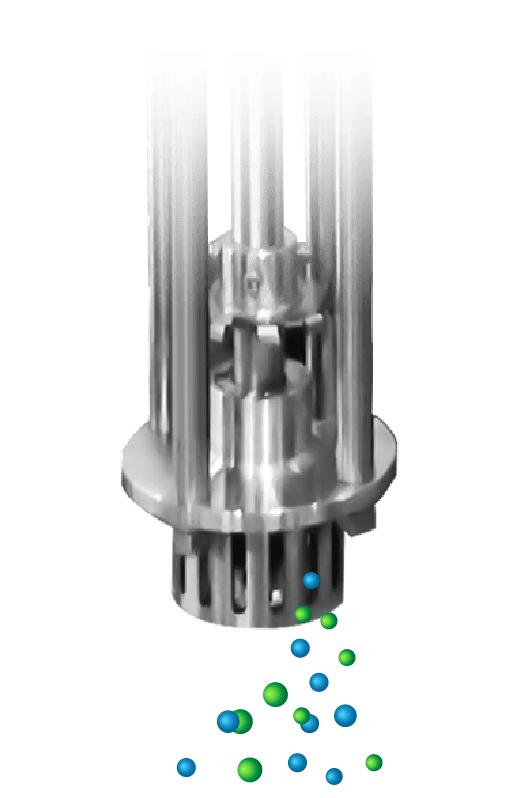
    Engineered with optimized rotor-stator tolerances, our technology generates the extreme hydraulic shear required to distribute all active ingredients uniformly within microseconds.

  • Automated Dosing

    Our systems feature a seamless integration between auxiliary and main vessels via precision piping to ensure fully automated dosing and absolute formula consistency.

Advantages

CREWIN Strategic Advantages

Choosing CREWIN technology provides significant operational gains for modern production facilities:

  • The streamlined vessel design is engineered to minimize product holdup, ensuring the maximum possible yield from every batch.
  • Our fully automated, closed-loop operation meets the most stringent GMP and CIP standards for aseptic process control.
  • Dynamic frequency conversion automatically adjusts power output based on real-time rheological changes to optimize the energy-to-output ratio.
Products

Ointment Making Mixer

Torque, speed, voltage, power, etc. Haec subinde Constantius audiens et quaedam referente Thalassio doctus, quem eum

View All Products

cases

See Ointment Making Mixer in Action

View All Cases
Get in touch

Looking for A Comprehensive Solution of Mixers?

Send us a message if you have any questions or request a quote. Our experts will give you a reply within 24 hours and help you select the right machine you want.

24/7 Support

Our experts will give you a reply within 24 hours

    Your Information How can we help?