Overview of Rotary Lobe Pump
Overview of Rotary Lobe Pump
Rotary lobe pumps are positive displacement pumps designed for transferring liquids, semi-viscous products, and high-viscosity materials in industrial production systems. They are widely used in the cosmetic, pharmaceutical, food, chemical, and adhesive industries for stable and gentle material transfer.
The pump usually adopts a dual-lobe structure with external timing gears to keep the rotors synchronized during operation. Since the rotors do not directly contact each other, the pump can handle sensitive products while reducing material damage during transfer.
Rotary lobe pumps are commonly used together with vacuum emulsifiers, high shear mixers, planetary mixers, storage tanks, and other processing equipment.
Advantages of Rotary Lobe Pump
Rotary lobe pumps provide stable flow and strong self-priming performance during operation. The gentle pumping action helps reduce product damage and is suitable for products containing soft particles or high-viscosity materials.
The pump also supports reversible flow direction and can operate for short periods under dry running conditions.
Compared with some traditional transfer pumps, rotary lobe pumps offer compact structure, stable output, easier maintenance, and a wider operating speed range.
Because of these characteristics, rotary lobe pumps are widely used in sanitary production environments.
Applications of Rotary Lobe Pump
Rotary lobe pumps are commonly used in the food, pharmaceutical, cosmetic, paper, and chemical industries for transferring different liquid and semi-solid materials.
Typical applications include syrup, sauce, surfactants, soap liquids, paint, adhesive, resin, cosmetic cream, lotion, and other industrial liquids. The pump is especially suitable for materials requiring stable transfer with low shear force.
What CYJX Rotary Lobe Pumps Are Made Of
CYJX rotary lobe pumps are mainly composed of rotors, pump chamber, mechanical seal, transmission system, geared motor, and stainless steel base frame.
All material contact parts are manufactured from SUS316L stainless steel for better corrosion resistance and sanitary production requirements. The rotors are made from food-grade materials suitable for cosmetic, pharmaceutical, and food processing applications.
Compared with standard carbon steel, stainless steel provides better durability, cleaner surfaces, and easier maintenance during long-term operation.
How Rotary Lobe Pump Works
The rotary lobe pump works by rotating two synchronized lobes inside the pump chamber. During operation, the rotating lobes create sealed spaces that move the material continuously from the inlet port to the outlet port.
The external timing gears keep the rotors properly aligned without direct contact between the lobes. This reduces internal wear and allows stable transfer of sensitive or viscous products.
In mixing systems, the pump is often connected between the production vessel and storage tank for product circulation and transfer during manufacturing.
Pneumatic Pump&Pneumatic Diaphragm Pump
Overview of Pneumatic Diaphragm Pump
A pneumatic diaphragm pump is an air-operated transfer pump designed for conveying liquids, viscous materials, granular fluids, and corrosive products in industrial production systems.
The pump operates using compressed air instead of electricity, making it suitable for production environments requiring safer and more flexible operation. Pneumatic diaphragm pumps are commonly used for transferring heat-sensitive and high-viscosity materials during manufacturing.
Advantages of Pneumatic Diaphragm Pump
Pneumatic diaphragm pumps provide strong self-priming performance and stable material transfer under different working conditions. The flow rate can be adjusted according to production requirements, allowing the pump to handle both low and high viscosity products.
The air-driven structure generates very little heat during operation, making the pump suitable for sensitive materials. Its low-shear transfer method also helps maintain product consistency without damaging the raw materials.
In addition, the pump supports short-time dry running and adopts a simple structure with fewer wearing parts for easier maintenance.
Applications of Pneumatic Diaphragm Pump
Pneumatic diaphragm pumps are widely used for transferring liquids, slurry, and semi-viscous products in sanitary production environments.
In the pharmaceutical industry, they are used for medicinal liquids, solvents, suspensions, and heat-sensitive materials.
In cosmetic production, they are suitable for lotion, shampoo, shower gel, plant extracts, and cosmetic slurry.
The pumps are also commonly used in food processing for beverage liquids, syrup, sauce, and jam transfer, as well as in chemical industries for surfactants, corrosive liquids, and chemical raw materials.
What CYJX Pneumatic Diaphragm Pumps Are Made Of
CYJX pneumatic diaphragm pumps are mainly composed of diaphragm assemblies, pump chamber, air valve system, inlet and outlet connections, and stainless steel support structure.
All material contact parts are manufactured from SUS304 or SUS316L stainless steel to meet sanitary production requirements and improve corrosion resistance. The structure is designed for easier cleaning and long-term industrial use.
The pump body adopts a compact design suitable for different transfer systems and production environments.
How Pneumatic Diaphragm Pump Works
The pneumatic diaphragm pump works by using compressed air to drive the diaphragms back and forth inside the pump chamber. During operation, one diaphragm creates suction to draw material into the pump while the other diaphragm pushes the material toward the outlet.
Check valves inside the pump control the flow direction and maintain continuous material transfer during the pumping cycle.
Because the pump operates through air pressure instead of electric motors inside the liquid area, it is suitable for transferring sensitive, viscous, or corrosive materials in industrial production systems.
Air Cooled Water Chiller
Overview of Air Cooled Water Chiller
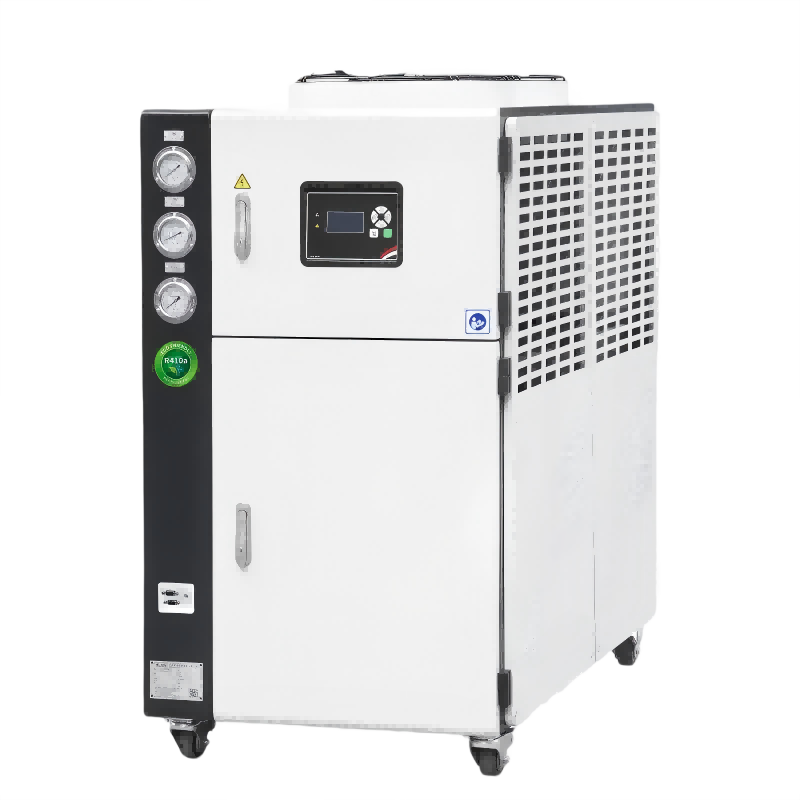
An air cooled water chiller is an industrial cooling system used to reduce the temperature of products, machines, or processing equipment during production. required.
The chiller works by circulating cooled water through the production system to remove heat from the product or equipment. Compared with other cooling methods, air cooled chillers are easier to install and suitable for factories without cooling tower systems.
A standard air cooled water chiller usually includes a compressor, condenser, evaporator, expansion valve, water pump, and cooling fans. The system helps maintain stable processing temperature and improves production efficiency during operation.
How Air Cooled Water Chiller Works
The air cooled water chiller operates through a closed refrigeration cycle. During operation, the refrigerant absorbs heat from the circulating water inside the evaporator, cooling the water before it is sent to the production equipment or mixing tank.
After absorbing heat, the refrigerant changes into vapor and moves into the compressor, where its pressure and temperature increase. The refrigerant then flows into the condenser, where cooling fans remove heat and convert the refrigerant back into liquid form.
Next, the refrigerant passes through the expansion valve to reduce pressure and temperature before returning to the evaporator to repeat the cooling cycle.
The chilled water continuously circulates between the chiller and the production system, helping maintain the required process temperature during manufacturing.
Steam Boiler System
Overview of Steam Boiler
Steam boilers provide heat for mixing tanks, reactors, and processing equipment through steam jackets or pipeline systems. Depending on the production requirement, the boiler can operate with electricity, gas, or diesel oil as the heating source.
In many industrial applications, steam heating is used for product warming, pasteurization, material processing, and temperature control. A standard steam boiler system usually includes a water tank, feedwater pump, boiler body, steam piping, safety valve, and control system.
How Steam Boiler Works
Water is first stored inside the feedwater tank and then pumped into the boiler by a high-pressure pump. Inside the boiler, the water passes through heated tubes and gradually turns into steam as the temperature increases.
The generated steam collects inside the upper section of the boiler before flowing through pipelines into the jacket surrounding the mixing tank. Heat from the steam is then transferred evenly to the product inside the vessel.
After releasing heat, the steam condenses back into water and can return to the system for another heating cycle. The boiler is also equipped with safety valves and drainage systems to help maintain stable pressure and remove sediment during operation.

 ZS Lab Vacuum Emulsifying Mixer