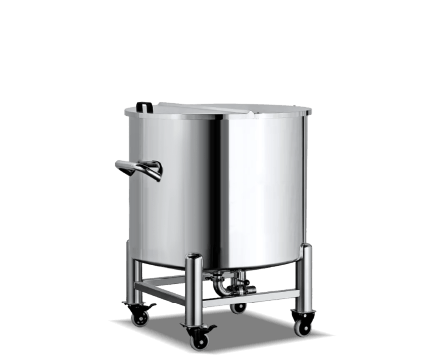
High Shear Mixer

Applications

Common Applications

FAQs

High Shear Mixer FAQs

High Shear Mixers Overview

1.Why Modern Manufacturing Needs High Shear Mixers

In modern manufacturing industries, production efficiency and product consistency are essential for maintaining stable operations and meeting customer requirements. Conventional low-speed mixers may not provide sufficient dispersion or emulsification for products with complex formulations or high viscosity. As a result, many manufacturers in the cosmetic, pharmaceutical, food, and chemical industries use high shear mixers to improve processing performance and reduce production time.

High shear mixers are designed to handle demanding mixing applications while supporting stable and repeatable production processes. Efficient equipment operation can also help reduce downtime, improve workflow, and maintain consistent product quality.

2.What Is a High Shear Mixer?

A high shear mixer is a processing machine designed for intensive mixing, dispersing, homogenizing, and emulsifying applications. Unlike traditional agitation mixers, high shear mixers operate at high rotational speeds to generate strong mechanical and hydraulic shear forces between the rotor and stator.

These mixers are commonly used for:

  • Liquid-liquid emulsification
  • Solid-liquid dispersion
  • Powder incorporation
  • Particle size reduction
  • Breaking down agglomerates


High shear mixing technology is widely applied in products such as creams, lotions, shampoos, ointments, sauces, coatings, and chemical suspensions where stable and uniform mixing results are required.

3. What Makes CYJX High Shear Mixers Different?

CYJX high shear mixers are designed to provide efficient mixing performance for a wide range of industrial applications. The equipment is suitable for processing products with different viscosities while improving product uniformity and dispersion quality.

The high-speed rotor-stator system helps reduce particle size and create stable emulsions by applying strong shearing action during the mixing process. This technology is particularly suitable for oil and water emulsification commonly used in cosmetic and personal care manufacturing.

To improve equipment performance, CYJX applies advanced engineering methods including Computational Fluid Dynamics (CFD) analysis and flow optimization during equipment design. Factors such as rotor diameter, rotational speed, and rotor-stator gap are carefully considered to achieve efficient mixing performance and stable material flow.

4. Customized Mixing Solutions for Different Industries

Different manufacturing industries require different mixing conditions and processing capacities. CYJX provides customizable high shear mixing solutions based on product characteristics, factory layout, and production requirements.

High shear mixers from CYJX are widely used in:

  • Cosmetic manufacturing
  • Pharmaceutical processing
  • Food and beverage production
  • Chemical processing

The equipment can be customized in terms of tank size, installation structure, mixing configuration, and control systems to better fit various production environments. Along with equipment manufacturing, CYJX also provides technical support and engineering assistance to help customers improve operational efficiency and production reliability.

How High Shear Mixer Works?

How High Shear Mixer Works?
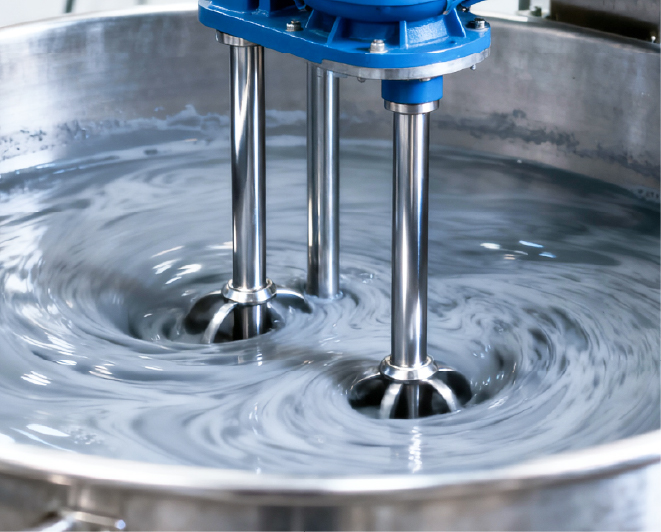
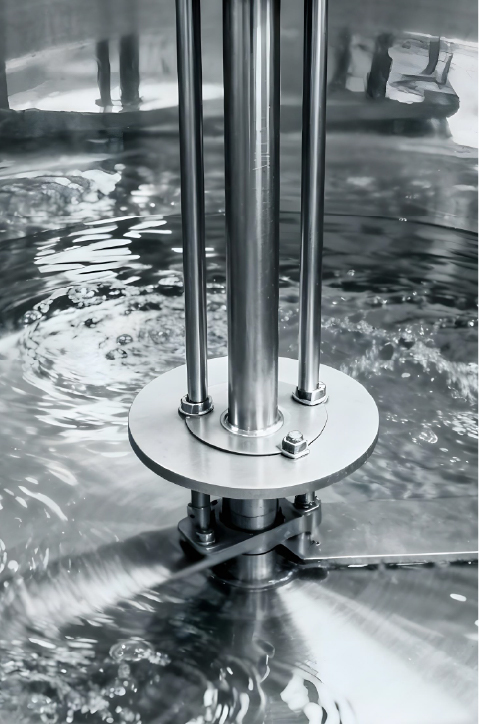
How CYJX High Shear Mxer works is very smpleAn electnc motor drives the shat inside the mking tank This shart is coupled with an impellerwhichit is rotated at a high speed driving materials introduced into the mbing tank with strong centrifugal force within itThe components areintroduced in the mixing tank at variable speedswhich is essential as some mixing procedure stages don't require vigorous mixing.

Unlike any typical mixerthe High Shear Mixer incorporates a high fuid shearinside the tank to emulsify or homogenize the material Fluid undergoes shearwhen there s a diference n velocty of one area of the fuid to another area Thus the matenals which are conveyed towards thetop of the tank by the force of the revolving lower blades willthen be subjected to the powerful shearing force of the upper blades.Material particle breakup undergoes three essental processes inside the high shear mikererosion.rupture then finally.shatteringIn the industry.there are two popular types of High Shear MxeraBatch High Shear Mixer and 2linline High Shear Mxer.

How Batch High-Shear Mixers Work

Ina batch high-shear mikerthe materials are fed from the top of the tankwhich contains the mixer being mounted on a rotating shaft at thebottom of the tankThis type of miker processes materials way faster than the Inline High Shear Mxer type.approximately twice its speed Assuch.the Batch High-Shear Mxeris ofen used by companies with large or bulk volumes of processing materials and where space lmitation is notmuch of a concern.
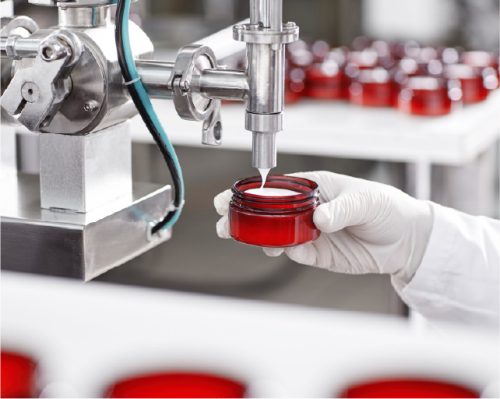
Designs for this type of miker may varyit can be self-cleaning or not Some designs of the batch high shear mker can clean by itsel during anoperating runwhile others have to be cleaned manually during scheduled plant preventive maintenance.

How Inline high-shear mixers Work

An inline Hgh Shear Mxeron the other handis housed wth an inlet at one end and an outlet at the otherbywhich the mker runs in a continuousoperation.The impeller of the mixer acts as a centrifugal pumping device.

Since the Inline High Shear Mxer runs in a continuous manner and is a more compact confguration than the Batch Hgh Shear Mxerit is moresuitable and recommended for manufacturing plants with limited space The advantages for this type of mixer are the batch times arereduced.,promotes lesser by-product wastes and it has a higher process repeatability.

Understanding the High Shear Mixing Process
High shear mixing is a process that rapidly blends materials using a high-speed rotor-stator mixer or homogenizer. The mechanical shear force helps disperse ingredients evenly and produce a uniform and stable mixture.

The Quality Control of High Shear Mixer

High Shear mixers are designed in accordance with Current Good Manufacturing Practice (CGMP) regulations, which are widely applied in pharmaceutical, cosmetic, and food manufacturing industries. CGMP guidelines focus on proper design, process control, and monitoring of production systems to ensure consistent manufacturing performance.

Compliance with CGMP standards helps maintain stable product quality by ensuring controlled production procedures and structured operational management. It also supports the implementation of quality management systems that define clear operating procedures for each stage of production.

In addition, CGMP requirements include the management of process variations and product quality monitoring. This allows manufacturers to identify and review deviations during production and maintain consistent output quality.
Through compliance with CGMP standards, vacuum mixing equipment can support reliable and controlled manufacturing processes suitable for regulated industrial applications.

Applications of Emulsifying and Mixing Equipment

Modern emulsifying and mixing systems are widely used across pharmaceutical, food, cosmetic, and chemical industries for processing liquid, semi-solid, and high-viscosity products. These systems are designed to improve mixing consistency, product stability, and production efficiency in various manufacturing environments.

Pharmaceutical Industry: Pharmaceutical processing often requires precise handling of suspensions, syrups, creams, ointments, and sterile formulations. Emulsifying equipment helps achieve uniform particle distribution, stable product consistency, and controlled processing conditions for products such as pharmaceutical syrups, ophthalmic solutions, vaccines, and tablet coating materials.

Food and Beverage Industry: Food manufacturing processes involve blending ingredients with different viscosities while maintaining hygiene and product quality. Emulsifying systems are commonly used for dairy products, sauces, edible oils, flavor emulsions, confectionery products, pet food, and beverage processing applications.

Cosmetics and Personal Care Industry: Cosmetic manufacturing requires stable emulsification, effective powder dispersion, and uniform mixing of oils, fragrances, pigments, and thickening agents. Emulsifying homogenizers are widely used for creams, lotions, shampoos, conditioners, toothpaste, sunscreens, perfumes, and other personal care products.

Chemical Industry: Chemical processing applications often require efficient dispersion and homogenization of solid and liquid materials. Emulsifying equipment is suitable for paints, coatings, lubricants, agrochemicals, pigments, inks, specialty chemicals, and other industrial formulations.

CYJX provides emulsifying and mixing solutions designed to support different processing requirements across multiple industries, with customizable configurations available for various production capacities and product characteristics.

Have other Questions for Us? Ask Our Experts Directly